Wednesday, July 08, 2015

Kijabe: The only Kenyan town with no bars

Kijabe is the only town in Kenya where you cannot purchase cigarettes or take alcohol.

Even with its population of 5,000 it has no bar and nobody is allowed to smoke. Kijabe remains the utmost centre of Christian faith - a citadel of purity!

Again, Kijabe might be the only town in Kenya whose economy has always centered around mission work and where any investor in the small town has to sign an agreement with the Mission that they would not sell alcohol or open entertainment joints.

It all has to do with the history of this town on the hill. The rise of Kijabe is credited to American missionary Charles Hulburt whose vision was to extend African Inland Mission (AIM) to “all directions” from Kijabe after he moved his headquarters there from Kangundo.

But initially, Hulburt was not interested in Kijabe and wanted to have his mission along the shores of Lake Naivasha. Here, Hulburt in 1903 had marked the land he wanted for his mission work but since it was a late afternoon the colonial administrator could not sign the lease. He was asked to come the next day. But unbeknown to him, Lord Delamere was also in Naivasha looking for land. That evening, after a couple of beers, the colonial administrator told Lord Delamere about the missionaries’ interests. Delamere thought that the land was so prime “cannot be wasted on missionaries.” The colonial administrator agreed and when Hulburt arrived next day, Lord Delamere had the lease of what is today Delamere’s Sosysambu Farm!

Hulburt was asked to take up a sport in Kijabe where at 7,200ft it was the malaria free, was cool and near the railway. But there were wild animals. Many of them!

The first task of Hulburt was to build a hospital. Hulburt was a friend of US President, Theodore Roosevelt, and he named the new hospital in Kijabe Theodora Hospital in Roosevelt’s honour. It was Hulburt who invited Theodore to Kenya in 1909 and he laid the foundation of the nearby Rift Valley Academy which was built for children of the missionaries. Theodore had left White House in March and on August 4, 1909 he laid that stone that is in the Kiambogo building of the Academy. Kiambogo is the original name of Kijabe and means the hill of Cape buffaloes that roamed the area. Until today, the beast remains the school’s mascot.

In his book African Game Trails, Roosevelt talked glowingly of Kijabe’s American Industrial Mission (as he called it). “Industrial teaching must go hand in hand with moral teaching…Kijabe will be an indispensable factor in the slow uplifting of the (locals).”

The growth of Kijabe, to become one of the largest mission stations in Africa, took a good turn when Indian shopkeepers followed the missionaries and set up dukas near the railway station. Kijabe was known. Letters to the missionaries were only written “Kijabe via Mombasa” and a local named Karanja Kago used to pick them from the railway station. Karanja’s wedding to Njeri wa Kiai was captured in the 1917 issue of Inland Africa since Njeri was one of the first students at Kijabe Girls.

One missionary, John Stauffacher was surprised that Kijabe was such a peaceful place. “There are none of the dangers I dreamt about…the people here are perfectly safe have none of those peculiar customs you hear about.” Another missionary who followed Hulburt was Elwood Davis and his wife Bernice Conger, a nurse who had graduated from Hahnemann College of Medicine in Philadelphia. The two missionaries had sailed to Africa under the banner of Africa Inland Mission and arrived in Kijabe in 1920 to work at the Theodora Hospital. Davis had a reputation as a skilled surgeon and made the hospital famous.

But in their early days, the missionaries found themselves at loggerheads with the Kikuyu Central Association supporters who opposed the rise of the mission stations and warning locals not to associate with it. After the initial warnings, the church attendance in 1920s is said to have dropped from 700 to 30 while the number of girls in Kijabe Girls School dropped from 300 to 80. The bone of contention then at Kijabe was whether female circumcision should be allowed. On the night of January 2, 1930, Miss Hulda Stumpf, the principal of Kijabe Girls’ was killed. As Bernice wrote in one of her memoirs, the KCA was telling them that soon “the mission will have to baptize baboons as their will be no more natives to baptize.”

But the couple continued drawing more adherents, planting lots of trees in the mission compound and keeping dairy cows.

Elwood is now known to have approached William Moffat, the sponsor of Moffat Bible Institute in Philadelphia, to start one in Kijabe. And that is how the modern-day Moffat Bible College in Kijabe opened doors on 11 February 1929. Soon, there was a printing press in 1950s solely for publishing Christian literature and later the Bibilia Husema Studios started by missionaries Bob and Lillian Davis, whose parents had worked there in the initial stages. Kijabe has continued to expand living to its purity. Still it has no bar after 110 years of its foundation.

Friday, July 03, 2015

Nyeri Diocese now seeks to declare 27 Mau Mau war victims as Martyrs

A petition has been launched by the Catholic Diocese of Nyeri seeking the declaration of 27 devotees who were killed during the Mau Mau war of independence as Martyrs. The move is set to open debate on whether they were “traitors” – and on the role of church in the war of liberation.

Nyeri was heartland of the Mau Mau struggle and still takes pride for contributing a large number of freedom fighters. The Catholic church has appointed Dr. Waldery Hilgeman as the postulator – to guide the cause for beatification or canonization through the judicial processes required as by the Church. The Archdiocese of Nyeri is listed as the petitioner.

Some two weeks ago, the Mau Mau War Veterans Association denied allegations by the Catholic Church that some 75 faithful were killed by the group because they were Christians. Freedom fighter and former Juja MP Gitu Kahengeri told The Standard that if the church was convinced they were killed because of their faith, then the Mau Mau veterans had no capacity to prevent the Catholics from declaring them martyrs.

To the Mau Mau, all those killed were traitors who “betrayed” the struggle for liberation and the nation. "Mau Mau never forced anyone whether Christian or not to take an oath. Furthermore, those who refused to take the oath were not killed, most of us are Christians even to date and Catholics for that matter," Mr Kahengeri said. Some of those listed include Italian born Marianna Cavallo and two sisters Wangechi and Njeri (pictured)

The following are the Catholics whose martyrdom is under review via a diocesan inquiry:

1. MARIANO WACHIRA GICHOHI Layperson of the archdiocese of Nyeri; married Born: 1893 in (Kenya)

2. JOSEPH GACHERU MWANIKI Layperson of the archdiocese of Nyeri; married Born: 1882 in (Kenya)

3. Domenic Nyota Kamwaga Layperson of the archdiocese of Nyeri; married Born: 1906 in (Kenya) Died: 09 December 1952 in Karuthi, Othaya, Nyeri (Kenya)

4. Aloys Kamau Layperson of the diocese of Murang’a Born: 1929 in Njombe, Tuthu, Muranga West (Kenya) Died: 04 April 1953 in Rwathia, Muranga (Kenya)

5. Natalina Gakui Mariano Layperson of the archdiocese of Nyeri; married Born: 1894 in (Kenya) Died: 16 April 1953 in Karuthi, Othaya, Nyeri (Kenya)

6. Ambrosio Kerengo Layperson of the archdiocese of Nairobi Born: ? in Karima, Othaya, Nyeri (Kenya) Died: 16 April 1953 in Shauri Moyo, Nairobi (Kenya)

7. CIRIACO KAHAICHA Layperson of the diocese of Murang’a Born: 23 March 1933 in Konje, Murang’a (Kenya) Died: 11 May 1953 in Murang’a (Kenya)

8. Dominic Wambugu Layperson of the archdiocese of Nyeri; married Born: ? in Tetu, Nyeri (Kenya) Died: 30 May 1953 in Tetu, Nyeri (Kenya)

9. FAUSTINO WANDUMA Layperson of the archdiocese of Nyeri Born: ? in Tetu, Nyeri (Kenya) Died: May 1953 in Tetu, Nyeri (Kenya)

10. Silas “Burana” Kibuci Layperson of the archdiocese of Nyeri; married Born: in (Kenya) Died: June 1953 in Ngandu, Mathira, Nyeri (Kenya)

11. LEAH MARY NYAGUTHII Young layperson of the archdiocese of Nyeri Born: 1934 in Gacuiro, Mathira, Nyeri (Kenya) Died: June 1953 in Gacuiro, Mathira, Nyeri (Kenya)

12. PETRO Njogu Njeru Layperson of the diocese of Murang’a Born: 1910 in Karimaini, Baricho, Kirinyaga West (Kenya) Died: 04 July 1953 in Kianyaga, Kirinyaga East (Kenya)

13. Peter mpui Layperson of the diocese of Meru; married Born: 1922 in Muthara, Meru (Kenya) Died: 14 August 1953 in Mikinduri, Meru North (Kenya)

14. Marianna Cavallo (Eugenia) Professed religious, Consolata Missionary Sisters Born: 16 February 1892 in Spinetta, Cuneo (Italy) Died: 28 September 1953 in Mujwa, Meru Central (Kenya)

15. Diomede Njoka Child of the diocese of Murang’a Born: 1938 in Karimaini, Baricho, Kirinyaga West (Kenya) Died: 16 October 1953 in Baricho, Kirinyaga West (Kenya)

16. Prassede Wangeci (Cecilia) Professed religious, Sisters of Mary Immaculate of Nyeri Born: 14 July 1922 in Tetu, Nyeri (Kenya)

17. Benedicta Njeri (Rosetta) Professed religious, Sisters of Mary Immaculate of Nyeri Born: 1914 in Gatanga, Muranga (Kenya) Died: 16 October 1953 in Kerugoya, Muranga (Kenya)

18. Lucas Mboge Layperson of the archdiocese of Nyeri; married Born: 1893 in (Kenya)

19. JOSEPH Wambugu Layperson of the archdiocese of Nyeri; married Born: 1890 in (Kenya)

20. Simon Ndegwa Layperson of the archdiocese of Nyeri; married Born: 1922 in (Kenya)

21. Rukwaro Layperson of the archdiocese of Nyeri; married; catechumen Born: 1920 in (Kenya)

22. Kuru MICINYO Layperson of the archdiocese of Nyeri; married; catechumen Born: 1925 in (Kenya) Died: 14 November 1953 in Mathari, Nyeri (Kenya)

23. PETRO Kamako Layperson of the diocese of Murang’a; married Born: 1899 in Zanzibar (Tanzania) Died: 21 November 1953 in Kianyaga, Kirinyaga East (Kenya)

24. Hibrahim Kaileki Layperson of the diocese of Meru; married; catechumen Born: 1920 in Mikinduri, Tigania East (Kenya) Died: 27 February 1954 in Mikinduri, Tigania East (Kenya)

25. Dionisio Wachira Layperson of the archdiocese of Nyeri; married Born: 1919 in Ithenguri, Tetu, Nyeri (Kenya) Died: 27 July 1954 in Mathari, Nyeri (Kenya)

26. Joanina Wakoori Layperson of the diocese of Murang’a; married Born: 1916 in Gitigiini, Kirinyaga West (Kenya)

27. Margaret Wambui Layperson of the diocese of Murang’a; married; catechumen Born: ? in (Kenya) Died: 26 March 1955 in Baricho, Kirinyaga West (Kenya)

Tuesday, June 30, 2015

Why a Kiambu village is known as Zambezi

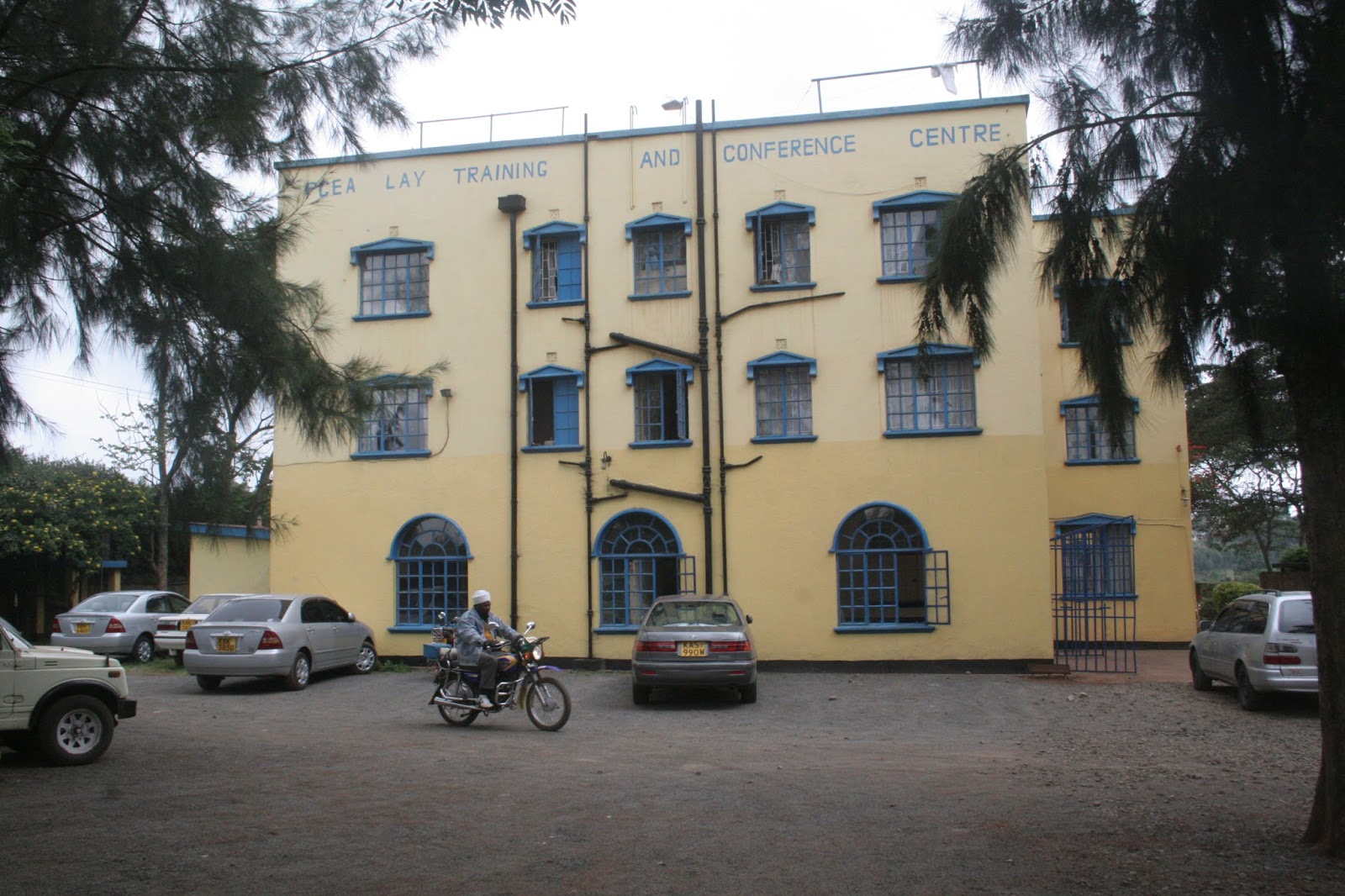
Nothing fascinates me than the PCEA Training Centre in Zambezi Kikuyu. Not that it is an extra-ordinary building but because of the past history. Of course few Kenyans know about this building – and its colonial bunkers- but at least those who have used the Nairobi-Nakuru Road know of Zambezi.

Now for many years this was the Zambezi Motel and it gave name to this village in the outskirts of Nairobi. Before it was re-opened on November 30, 1963 as the new Zambezi Motel, it had been lying desolate after it was abandoned by its previous owner.

That time, according to records, a 24-year Mrs Josephine Aron and her husband Sigi had decided to rehabilitate the building as the “best gesture of our faith in this lovely country”.

Josephine’s husband, was a land and real estate agent. Having worked in both Rhodesia and Zambia, he had fallen in love with the Zambezi River and wanted to immortalize his love by naming the 65-bedroom business, Zambezi Motel. It was actually the only motel, worth its name in Kenya. They also named their two cats, Zam and Bezi.

Designed to be a stop-over for motorists, it was expensively furnished, and had a site for caravans. A single would cost Sh 25 while a double was Sh45 by 1963. And by 1969 this had climbed to Sh45 for single ands Sh 80 for double. Zambezi was actually a luxurious stop over but before it was renovated it was simply Njogu-Inn. Owned by Mrs Berkley Mathews, Njogu-Inn was perhaps the best known hotel on the Nairobi-Nakuru Road. Her Husband E.J.H Mathew used to own the Kikuyu Estates – a huge swath of land which was later sold to James Gichuru, the pioneer minister for finance.

Mathews was one of the settlers who did not want to sample life under an African government and in 1963 shortly before independence she had offered it for sale for £32,000 – the entire building and its contents. But there were few takers for this. As more property was thrown into the market and with the fear of an African-led government reaching crescendo, the value plummeted to £6,000 and that is when it was purchased.

In one of her last interviews with a Kenyan paper, Mrs Mathews remarked: “We are sorry of course, but it is one of those things. We have already got rid of everything else…”

Njogu-Inn had been completed in 1953 just as the Mau Mau war broke. It was a bad investment; a bad bet. The owners had started constructing it in 1947 – the year that Jomo Kenyatta took over leadership of Kenya African union and started agitating for change. But few foreign investors thought that the “white man’s country” – as they called Kenya – would end up with an African government. Certainly not the Njogu-inn proprietor. But to safeguard her clients she build some bunkers underneath the building that were furnished too. Here, nobody would reach the clients – and even today, few at this church building know of these dark corners.


I recently came across an old review of Zambezi and the owner was grumbling that because it was far from the City, it was putting people off. Although she at one point dropped the cost of a double from Shs 80 to Sh 35. It failed to make economic sense. As the dollar crisis began in 1970s throwing the tourism industry into a spin. She sold it to PCEA Church as their training centre.

But the name she had abandoned Njogu-Inn for Zambezi had been picked a River Road trader who opened a hotel known as Njogu-Ini. It had the Njogu-Inn logo of an elephant although it means the place of elephants. How a place of worship was a beer hole is the untold story of Zambezi. Njogu-ini, the River Road bar, has survived ever since and Zambezi, the name, is now a village in Kikuyu. History continues…


Thursday, June 25, 2015

All we know about statue outside Kenya's Supreme Court

The statue of a naked boy holding a fish marks the entrance to the Supreme Court of Kenya. It used to be known as Hamilton Fountain. This statue was ordered during the Second World War by Mrs Getrude Hamilton. It was supposed to be placed in Nairobi as a living testimony to what her late husband and lawyer, George Alexander Hamilton who died in 1937 stood for: justice.

However, this is not the original statue that Mrs Hamilton had ordered. The original was packed aboard a cargo ship in England but the ship sank in the Indian Ocean.

Saddened by the loss, Mrs Hamilton ordered a replica which was erected outside the law courts of Nairobi. It never lasted for long as somebody stole it. The Nairobi City Council which had been mandated to take care of the statue commissioned Kenyan sculptor Robert Glan to mold another one.

Glan did it with it faint pictures of the original and whatever lay at the bottom of the ocean. It still stands today.

Tuesday, May 19, 2015

Who will restore these Nairobi symbols of the past?

South Africans have managed to topple the statue of Cecil Rhodes from University of Cape Town and they are moving to vandalise other statues connected to the imperialist past.

In the rage, the statue of Mahatma Gandhi was also vandalised. We don’t know where they will stop.

They are wrong – and we were wrong in 1964 to remove the statue of Lord Delamere from the junction of Kimathi Street and Kenyatta Avenue, the King George V statue and the bronze portrait plaque on the King George VI memorial near Intercontinental Hotel.

Recently, at the Jevanjee Gardens in Nairobi, the statue of Queen Victoria (below) was destroyed by some vandals – denying future Nairobi generations to have a glimpse.

Empty plinths will never tell the story of a nation, however painful. Otherwise, how do we tell the authentic and balanced history of our colonial past while we have distorted the landscape where they sat?

While the fall of any regime is usually followed by the removal of its images and symbols, removal of monuments, memorials and statues is usually the first sign of intolerance. There is no monument that cannot be contested in space and time.

Germany removed the Nazi monument after the Second World War only for it to be rebuilt in 1988 to provide a link between the past and present non-Nazi generation. It is now a reminder of the fascist past and offers a symbolic dialogue to citizens.

In 1964, Kenya erected the statue of Jomo Kenyatta which was unveiled outside Parliament. Some 10 years later, another statue was unveiled outside Kenyatta International Conference Centre.

The two captures the history of Kenya in the formative years and any maverick who would target them in years to come would have done a disservice to history. The same goes to the Tom Mboya and Dedan Kimathi monuments in the central business district.

Perhaps we have been lucky, so far. President Kibaki did well to have resisted pressure to erase the Nyayo symbols and monuments that remind Kenyans about the dark days of Kanu.

Virtually every major town has these symbols – their architectural and aesthetic wants notwithstanding. There was an attempt to deface the Nyayo monument at the Central Park and police were called in and repairs later made. That is how nations should protect their past.

The world watched as Saddam Hussein’s statues in Firdaus Square in downtown Baghdad were brought down by US Marines which was the first attack on symbolic images on a nation’s political and cultural heritage. Is it any wonder that there is an ongoing destruction cultural monuments in Egypt, Iraq, Libya and Syria by Islamic State? They have so far destroyed the statue of Abu Ja’afar Al-Mansour, the founder of Baghdad and the tomb of 12th-century philosopher, Ali Ibn Al-Athir.

When a nation refuses to acknowledge its past and appreciate the aesthetic and historical value of statues and memorials, then it loses an opportunity to dialogue with the past. No nation should settle scores with monuments and South Africans need to learn this.

Having said that, Nairobi should return the statue of Lord Delamere from the shores of Lake Elementeita to its original plinth. We cannot use sites and monuments to settle old scores.

We should start seeing the monuments as part of our heritage, as historical artefacts and as symbols of the past. Or do we think that the French are crazy to have maintained Arc de Triomphe despite the fact that it was associated with Napoleon Bonaparte – a man who almost destroyed France.

For public historians, it was gratifying that President Robert Mugabe said they will keep the grave of Cecil Rhodes in Bulawayo although some ZANU-PF members have been calling for his exhumation and repatriation to Britain. Governor Evans Kidero, should help Nairobi restore its symbols.

Friday, May 15, 2015

Eldoret, the town that South African Boers started

Let us celebrate 100 (plus) years of Eldoret.

If you look at the old Kenya Gazette Notices of 1912 (and they are now online) you will find that most of the locations in Uasin Gishu had no names on government records. They were simply: Farm 1, Farm 2, Farm 3…

What is today Eldoret Town fell on Farm No 64 and for many years the town was simply known by that number. One of the cheeky stories of Eldoret was about the trust that pioneers traders had in each other. There is of course the hard-to-verify tale of the unmanned pub where revellers would walk in, drink and leave the money at the counter.

Space to breed

It is also the story of how some two revellers one day found the door locked (by mistake) and they removed the door, drunk the beer, paid and left. For many years, some historical wags say, the bar remained without a door! But seriously, the story of Eldoret is worth a tome. It was built by Boer rogues who had decided that they had had enough of British rule in South Africa and trekked north to protest the annexation their Transvaal Republic and Orange Free State to South Africa after the Second Anglo-Boer War of 1988-1902.

It was in 1909 when a heavily-armed group of 280 Boers arrived in Kenya from South Africa. With them were prefabricated houses, wagons, ploughs, cattle and sheep. They wanted land, if not peacefully, by force. And they were willing to fight.

The Nandis were elbowed out of their farms around Uasin Gishu as they cut huge chunks for themselves and that had been surveyed by Royal Engineers. Their leader Meneer Van Rensberg had arrived in Mombasa with another group aboard a German vessel, Windhoek, and by July 1908 he was in Nakuru where he was directing the new farmers.

The families that set out for Uasin Gishu had heard stories of land that looked like the South African kopjes. Here, they spanned out with the single believe that “here is a land where our women can breed in space…”, according to Negley Farson in his 1947 book ‘The Last Chance in Africa’.

Colonial writer, Elspeth Huxley in her book ‘No Easy Way’ captured the drama too: “To get heavily-loaded wagons up this steep escarpment along the rough, narrow, treacherous track, with inexperienced oxen and in a wet year, was a truly remarkable feat, and only Afrikaners could have performed it...”

Heavy safe

Every time I look at the Standard Chattered Bank in Eldoret, it reminds me of the story of a heavy safe that had been brought in from South Africa by the boers and was full of cash.

It was at Farm 64, the story goes on, that the safe fell and the few boers present could not lift it back to the wagon.

To protect it, they built a bank around it — a branch of the South African Standard Bank! But the South African bank at first refused to have a branch in a mud house but later gave in. A historian, A.T Mason recalls the arrival of the instruments to operate a bank: “All the paraphernalia of city banking arrived, including a brass plate, which was quickly affixed to the mud and wattle wall.

On one occasion, its manager J.C Shaw told the office boy to patch the flaking mud but the Kiswahili of both the manager and worker was meagre with the result that when Shaw returned he found the wall had disintegrated under repeated onslaughts with buckets of water and the safe was outside in the mud!”

For a long time, Eldoret was the only town where the Boers used Kruger coins as currency, and for a long time – even after they were not in use in South Africa.

Also, they protested any sign of British control and got away with lots of murder and mayhem.

Today, the agricultural town they started has grown beyond Farm 64, just after 100 years. It is a lengthy story…

Wednesday, May 13, 2015

Nairobi was built in the wrong place

When Nairobi was hardly eight years, the administrators were warned that they had done a mistake by allowing the building of a town in a treeless windy plain where residents were constantly baked by the African sun.

Medical officers warned in 1906 that the grounds were soggy and urged Sir James Hayes Sadler, the then Commissioner of the East Africa Protectorate, to plead with London and have the town moved. As usual, bureaucracy reigned and railway interests surpassed the wishes of the majority.

One has to look at the 1902 letter written by Sadler and which said in part: “Doctors are unanimous in condemning this site. They pointed out that it was a depression with a very thin layer of soil and the decomposition of animal matter was abnormally slow. It should be removed”.

The original city fathers wanted the place moved. Shortly after the swampy conditions induced a plague breakout out in 1901, colonial medical officer Dr. W.H. MacDonald worried that the city was in the wrong place. In May 1903 Dr. Moffat, principal medical officer of the East Africa and Uganda Protectorate, called Nairobi dangerous and defective. After another plague in 1904, he recommended relocating residents to modern-day Kikuyu Township. But Moffat left in April 1904, and his successors held the costs of relocation too high.

On 18 May 1906, Sir James Sadler, commissioner for the Protectorate, wrote to Churchill, Undersecretary of State for the Colonies, complaining about the emergence of Kenya's capital: "...at the commencement of the 1902 plague...the then-commissioner, Sir Charles Elliot, was strongly of the opinion that the site, which had been selected three years before by the manager of the Uganda Railway without consulting medical or sanitary authorities, was, with its inadequate drainage, unsuitable for a large and growing population. [It is a] depression with a very thin layer of soil or rock. The soil was water-logged during the greater part of the year."

Churchill was reminded that four years previously, it had been recommended that the town be moved "to some point on the hills." But railway engineers did not see Nairobi as becoming anything more than an Indian township—which, they argued, could "prosper in spite of unsanitary conditions and chronic plague."

Sadler told Churchill this was a critical point in Nairobi's history; that his predecessor had said: "...when the rainy season commenced, the whole town is practically transformed into a swamp." But the Board decided instead only to try to drain the swampy bazaar area.

Nairobi continued to develop quickly and Sadler finally threw in the towel: "It is, I admit, too late to consider the question of moving the town from the plains to the higher position along the line some miles to the north. We had a chance in 1902, and I think it was a pity that we did not do so then as advocated by Sir Charles Elliot." But even Sadler did not anticipate the growth, saying Nairobi would never become "a city like Johannesburg or a large commercial centre, for if there is a rapid development of industries or minerals in any of the new districts, the centres would spring up around them."

Churchill accepted this idea and made the final decision: "It is now too late to change, and thus lack of foresight and of a comprehensive view leaves its permanent imprint upon the countenance of a new country."

By the time the Nairobi Sanitary Commission was appointed in 1913, to enquire and report upon the sanitation and drainage of the township, the town had taken shape. It was now left to the engineers to build a city with the challenges that soggy ground presented. Many years later, failure to consult experts could make many buildings in the city uninhabitable in a few years' time - or we look for ways to manage mother nature.

Tuesday, August 28, 2012

Wilfred Karuga Koinange: Was this the Goldenberg Fall Guy?

By John Kamau
Sometime in January 2009, Goldenberg suspect Dr Wilfred Karuga Koinange, who died yesterday, walked us past his empty car yard in Kiambaa where two rotting tractors, a broken down lorry, and other vehicle shells lay. Apart from a water bottling plant – he bottles Broomhill Springs water brand – there was little other economic activity in this expansive farm.

Down the undulating hill lay a spring which Dr Koinange protected as his last source of income. “It is the only naturally carbonated spring in Kenya”, he says. From here, ever since he was accused of stealing Sh 5.8 billion via the Goldenberg scheme – a fictitious mineral compensation project that was hatched by Kamlesh Patni – the former Permanent Secretary in the Ministry of Finance had retreated into this farm with well-trimmed cypress hedges.

“I usually come to this house for solace,” he says without coaxing. [We walked on] The house, a colonial bungalow with aging terracotta tiles and polished wooden floor, has a backyard with a round hut. “I can spend my day there reading books and listening to music.”

Dr Koinange cut the image of a lonely man and this was no longer his family home. His well stocked library had many interesting biographies – including President Moi’s ironic biography “The Making of an African Statesman.” “Do I look like a person who swindled the country billions of shillings?” he asked as we sat at the backyard. We opened the backdoor to a tiny sitting room that had a well stocked fridge: Wines, spirits, sodas, beers and Broomhill water. “Take whatever you want,” he offered me and a senior Oxford University historian who was researching on the Koinange family.

Unknown to many, Koinange was a history buff. He has one of the best collections of history books and rare colonial documents. He was also a great collector of African music and plants that dot his farm. Each flower type, he told us, had a history, and each tree told a different story. “The next time you come, I will play for you the banned Muthirigu songs”, he promised. Muthirigu was a Kikuyu dance banned by the colonial government for ridiculing the settlers. Koinange loved to sing too – and would mellow when asked something historical: But not on Goldenberg scandal and the tribulations he was going through ever since he was first arrested over the Goldenberg scandal. “This case has exhausted me,” he tells us long before he pleaded to the courts to give him a defence lawyer.

Dr Koinange was angry that after all those years in government service, he was left fighting to clear his name over the theft of billions of shillings via a signature he had appended. In his court papers he does not deny that he authorized the three payments to Goldenberg International but told the Commission of Inquiry investigating the matter that he was commanded by President Moi to do so.

He told Bosire: "I telephoned the president and told him I have been informed by Prof Phillip Mbithi that I should pay out all the amount outstanding to Goldenberg International and the president said yes, I have spoken to Prof Mbithi." Koinange signed three letters: 19 April, 1993, 28th June, 1993 and 8th July 1993. They sealed his fate. Moi, through his lawyer Mr Mutula Kilonzo, denied ever ordering Koinange to make the payments which left him as the fall-guy in the unending drama.

Koinange’s letter were given to Mr T. K Werunga, an assistant Principal in the CBK’s banking division. Werunga, photocopied the letter and instructed a Mr Muraya (a clerical officer) to carry out Dr Koinange’s instructions. Although Dr Koinange’s specimen signature was not with the bank, since as the PS is not the accounting officer ( a position held by the financial secretary), the CBK went ahead and made the payments. “I am writing a book that will tell the story,” he told us. Fortunately, Dr Koinange died without telling his side of the story. During the Goldberg hearing, Dr Koinange acknowledged the illegality of his actions. Dr Koinange was at the Treasury at the wrong time. A man who had no knowledge of the workings of the Ministry of Finance, he had been catapulted from being Director of Medical Services (1979 – 1987) to PS ministry of research, science and technology. Here, he seemed to fit the professional bill, though this was far removed from his training as a medical doctor; a man who was proud to be a Fellow of the Royal College of Physicians Edinburg. Because he could not understand the inside workings of Treasury, senior officials at the Treasury, including his co-accused, the late Eliphaz Riungu, a former Central Bank deputy governor, would cook figures on foreign exchange to impress both the World Bank and IMF on the government performance. When Riungu was asked by the Justice Bosire Commission why he did that he would simply say: "We were cornering the IMF, we were being cleverer than them." Was Dr Koinange part of this syndicate? Perhaps. During the Goldenberg hearing, it emerged that Dr Koinange had sought the CBK Governors word on the payments. He told the Commission that indeed it was the then CBK Governor. Eric Kotut who authored the infamous authorization letter. Mr Kotut denied this on oath.

The Justice Bosire Commission appeared to absolve President Moi from blame which left Dr Koinange holding the smoking gun: “There is no clear evidence that the President asked for money to be paid which was in fact due to Pattni or Goldenberg International., and it would certainly have been possible for Dr Koinange to tell the President that the money was not due.” [Justice Bosire was found unsuitable to be in the judiciary for failing to summon senior government officials, including President Moi who had been adversely mention during the sittings.] The death of Dr Koinange has left many unanswered questions on his role in this fictitious export compensation project that saw mandarins behind the Goldenberg scam penetrate CBK and milk Sh5.8 billion from the coffers. “There was no legal claim to the money, in the manner in which it was paid out….Dr Koinange purported to rely on a letter from Customs which cannot be interpreted to be a statement that any money was actually due,” said the Goldenberg report which recommended Dr Koinange’s prosecution.

“The PS Treasury Dr Koinange, the Governor and his Deputy Mr Riungu were personally responsible for this (loss). Dr Koinange’s assertion that he was ordered by the former President to pay out Sh 5.8 billion is doubtful. He and the Governor of CBK, among others both in Treasury and CBK, were the economic managers….if as he says a decision was reached to pay out in a discreet manner it is only fair that they bear the responsibility for the illegal payments.” That haunted dr Koinange for long. He hired good lawyers. Kept tabs on his case and never missed a mention. He looked weathered in court appearances as his co-accused succumbed to cancer. With his resources dwindling and his frantic efforts to clear his name coming a cropper, Dr Koinange died with a huge burden.

“My main worry is that my name will forever be tarnished…I am not a thief” I recall him saying. We went to his father’s grave, where the notables of the Chief Koinange wa Mbiyu’s family were buried: took photos and left. Only one man knows whether Dr Koinange was innocent: Former President Moi. Did he make the call that changed Dr Koinange’s life? john.kamau@gmail.com

Friday, September 09, 2011

John Ainsworth- the man who built Nairobi

The name John Ainsworth may mean little today.
But this was the man who built Nairobi and planned it from scratch albeit with little support from London.
After arriving in town from Machakos, much to the chargrin of the railway administration Ainsworth built his house at Museum Hill to oversee the government administration.
Although he stayed for a little period, upto 1906 when he was transferred to Naivasha, Ainsworth had left a legacy.
By the time he left in the town had naturally sorted itself into seven districts then named Railway centre, Indian Bazaar, Railway Quarters, European Business and Administrative Centre, The Dhobi Quarters, European Residential Areas, and Military Barracks Lions normally laid a state of siege near the Norfolk Hotel while down at the swamp, frogs kept the town busy as they croaked in unison.
The demarcation of roads and plots had began in 1900 and four streets were planned in the Bazaar to be called Station Street, River Street, Punjabi Street and Khoja Moholo Street. But after the 1902 plague it was moved towards the current Biashara street.
Elspeth Huxley recorded the events in her book White Man's Country: "The town consisted of one cart-track recently labelled Government Road (Moi Avenue) flanked by Indian Dukas. Beyond lay the swamp where flogs lived…every night at dusk they used to bark out their vibrant chorus and spread a cloak of deep, incessant sound over the little township. The frogs were accepted as regular inhabitants of the town".
"Lions lurked in the papyrus swamp, and I really should not like to say how many were shot by the present sub-commisioner".
It was Ainsworth who started planting the blue gum trees that now stand in Nairobi today. He started by planting the trees around Moi Avenue, next to the Central Police Station and moved to other highways. Majority of these trees can be found in upper hill.
A treeless plain bored Ainsworth and he brought the seedlings from Machakos where he had been based.
He also lined the muddy strets of the railway town, a legacy that is still visible today in many parts of the town.
The European surburbs were at the hill (upper hill and State house road area) while the indians crowded at the Baazar. The Africans were to the east with the exception of Kileleshwa where a large African village existed.
In 1902 Mayence Bent had opened the first hotel in Nairobi on Victoria Street (now Tom Mboya) the second floor of on a store owned by Tommy Wood. The store also served as a post office. Tommy Wood is remembered as the town's first Mayor. Soon the hotel became too small and moved next door and renamed Stanley Hotel.
A proposal to build a church was accepted and the construction commenced just at the same time A.M. Jeevanjee started work on the first town hall. Also construction of Racecourse Road began. The first mishap for Nairobi happened in 1904 when the "great fire of Victoria Street" consumed Mayence Bent's Stanley Hotel just at the time Major Ringer and Aylmer Winearls were building Norfolk Hotel.
This was a blow to Nairobi and Mayence had to move her clients to another building. She named it Stanley Hotel.
When the notorious Meinertzhagen visited Nairobi in 1906 after his 1903 visit he was surprised by the changes.
"Trees have sprung up everywhere. Hotels exist where Zebra's once roamed. Private bungalows in all their uglines mark the landscape where I used to hunt waterbuck, impala and duicker", he wrote.
It was in 1909 that Mayence bought a plot at the corner sites of Sixth Avenue (Kenyatta) and Hardinge Street (Kimathi) to put up a hotel. The plot went for £350. Construction started in 1912 and by 1913 the first New Stanley Hotel was opened. The old Stanley Hotel continued to operate. (Excerpt from A Short History of Nairobi by John Kamau, coming soon)

Friday, June 10, 2011

When History caught up with Nancy Baraza


History caught up with Nancy Baraza this week. It will soon catch up with many others aspiring for high office.

It was in 1990 that Ms Baraza - the lawyer who wants to be our deputy chief justice- joined hands with Aaron Ringera, Phillip Kandie, and Nesbitt Onyango (then all Law Society of Kenya council members) to seek orders to have Paul Muite, then LSK chair, barred from releasing “political” statements on behalf of the legal fraternity.

Others sued with Muite were then LSK’s vice-chairman, Willy Mutunga, who wants to be our Chief Justice, lawyer Mr Japheth Shamalla, Mr Charles Nyachae, (now the chairman of the Commission for the Implementation of the Constitution, Ms Martha Njoka (now Martha Karua), Mr F. Kagwe and Mr G. B. M. Kariuki.

The Nancy Baraza group wanted this group sent to jail for contempt of court after they defied orders issued by Justice Norbury Dugdale and Mr Justice Joseph Amonde Mango, barring them from making political statements.

When this question was thrown at her - thank you Millie Odhiambo - during the parliamentary vetting exercise, Baraza said she was then naive and wanted to save the law body from being proscribed by President Moi. Perhaps, some of us do not buy that line, but an activist wag told me this week that she was forgiven by Muite and the civil society.

Again, she managed to redeem this black spot on her career by becoming an activist - for the better.

And that is a lesson that all those who aspire for higher offices should learn. What you do, in your moment of naivety or madness, will always haunt you. Remember Bill Clinton on the marijuana: “Yes, I smoked, but I did not inhale”, he said.

For those who followed the Muite case those days, it came at a time that only LSK dared to confront the excesses of President Moi. The judiciary was rotten to the brim and failed to protect the rights of citizen.

Muite stood out. He told the court that it was the business of LSK to talk on human rights violations, over concentration of powers in the presidency, subordination of other institutions and emasculation of parliament. These are the issues that would later inform the struggle for multi-party politics and the Constitution that we have today.

The Nancy Baraza group felt that LSK should restrict itself to the narrow objective of disciplining and licensing of lawyers and that the Muite group was out of tune.

Muite finished his tenure without doing too much as this group managed to scuttle his efforts to use the LSK to raise serious issues of political leadership in this country.

Which takes me to the next issue. Moi had a rotten Judiciary. I recently fished out correspondence, which I have on former Chief Justice, Cecil Miller (then chairman of Kenya Law Reform Commission) as he spent time in Mombasa looking for beach plots. He would write secret letters seeking favours from Kilifi District Commissioner S.M Komu, Coast Provincial Commissioner Yusuf Haji, and his predecessor, Luka Daudi Galgalo, on the same. He would drop the name of President Moi as he did this.

Miller did this immediately he finished nailing Charles Njonjo during the Njonjo Commission of Inquiry of 1984. So what do we see here? Abuse of office. If Miller was alive today, he would be embarrassed if these letters are read in public.

And that is a lesson to all those who want high office. Look back and be afraid. Very afraid.

Wednesday, March 30, 2011


The rise of Sam Waruhiu; Kenya's blue chip lawyer
By John Kamau
When he appeared at the High Court in 1969 as the lawyer for Nahashon Njenga Njoroge - the man who was accused of killing Tom Mboya - Samuel Waruhiu was at best a novice.
He said as much.
Two years earlier, he had arrived in the country bubbling with energy having graduated with a law degree from the University College of Wales. But he was not prepared to handle a case that was to throw him to the centre of politics and law in Kenya.
Waruhiu, who passed on yesterday in Nairobi, had been called to bar in 1967 at Middle Temple and was returning to Kenya to join a small army of African lawyers and political elites who were shaping the path of a new nation.
But the Tom Mboya crisis and the Cold War politics had torn the Kenyatta government and divided the nation further as the succession struggle took a nasty path. In the political jumble, Mboya was assassinated and the young Waruhiu, who was not even a criminal lawyer was approached by Njenga’s wife, Grace, to take up the case “otherwise you (Waruhiu) would not live”. He was warned.
That must have been threatening given that his father Chief Kungu Waruhiu had been assassinated on October 7, 1952 triggering Governor Everlyn Baring’s declaration of a State of Emergency in Kenya.
Although he lost the Njenga case, Waruhiu’s image rose like meteor.
At the African Club, along modern day Monrovia Street in Nairobi, he would hobnob with other elites and beneficiaries of Mboya’s airlifts to US universities. From here, he would socialize – and when free he would retreat to playing golf at the Sigona Golf Club, where he became the first African chairman of the club in 1974.
But it was his entry into the boardrooms of blue-chip companies – and at a young age – that catapulted him into riches. He was by 1974 the chairman of Old Mutual and by 1990’s he was chairman of Barclays Bank.
Waruhiu had earned respect among the powerful Kiambu politicians and especially Kenyatta who had lots of respect to his late father. It was at the elder Waruhiu’s funeral that Kenyatta attended one of his last public meetings before he was arrested.
That Waruhiu would be headed for big tasks, albeit controversial, in the Kenyatta government emerged on the year he returned to Kenya in 1967. That year he was picked up to chair a board of inquiry that was to recommend on the composition of Teachers Service Commission and the place of Kenya National Union of Teachers. The inquiry was to avert another national teachers strike similar to the one staged in 1965. Waruhiu performed well together with Rev Andrew Hake. But though not all his views were accepted, he laid foundation for new thinking within KNUT that was picked up in 1967 by Jeremiah Nyaga when he took up the ministry of education.
One of the first students at Kabaa-Mangu High School – as Mangu High was briefly known – in 1940s, Waruhiu would balance his legal activities with business building a law firm whose clientele read like a who-is-who in the business sector.
While his brother, George, founded Waruhiu and Muite Advocates, Sam would practice under the umbrella of Waruhiu and K’Owade Advocates.
With money flowing, and investment opportunities galore he would partner with the likes of Dr James Sidney Nesbit to purchase choice plots in Mombasa joining other elites in the mad rush to acquire wealth. Their company Neswa Investment Limited whose two shareholders were listed Samuel Njoroge Waruhiu and Nesbit took several acres of land at the beach.
But Waruhiu will be remembered for his 400 page Report that he prepared in n1980 after he was appointed by retired President Moi to look at the terms of service for civil servants. Following the footsteps of Duncan Ndegwa, whose report recommended that civil servants be allowed to do business, the Waruhiu Report solidified that thinking. It was a thinking that was opposed by the likes of Habel Nyamu, a career civil servant, who always felt that this is the heart of corruption within government tendering system.
Interestingly, Waruhiu was not interested in politics. But he will be remembered as the chair of the Trading Appeals Tribunal that enforced Africanisation policy in the commerce and industry. It was a body that laid the foundation for indigenous Kenyans entry into business.
By the time of his death, Waruhiu was no longer listed as a practicing lawyer by the law society of Kenya and was not under any law firm having sold his interest in the Waruhiu and K’owade.

Sunday, January 09, 2011


The Story of GK Kirima


By John Kamau
Sometimes in mid-2005 Nairobi property magnate Gerishon Kamau Kirima, frail and crutching on his walking stick, limped into Nairobi’s Market Branch of Barclays Bank with a bag full of cash. He was alone.
A few minutes later, a middle-aged woman rushed in and publicly admonished him for carrying large amounts of money along Nairobi streets. It was end month and it could have been money collected from his rental houses, which bring in more than Sh 17 million a month, according to court records.
Few discerned that this was perhaps one of the wealthiest rags-to-riches Kenyans alive. Unlike other flashy millionaires, Kirima’s style of running business was rudimentary, just like the furniture he made in his early years.
By the time he died aged 88 in a South Africa hospital while undergoing treatment on Wednesday, Kirima and his family had for the wrong reasons become the center of attention as the family fought in and out of court corridors for the control of his multi-billion real estate and other commercial ventures.
It was a drama that had all the tenets of a soap opera: cash, witchcraft, back-stabbing, and litigation. Kirima hardly controlled it, and was more of a spectator, as old-age and senility caught up with him.
Born in the tea-growing Kiruri village in Murang’a and on the slopes of Aberdares, Kirima was a simple man whose dressing, mostly v-necked sweaters with a suit, hid his business acumen and wealth, but revealed his humble backgrounds. Scrupulously honest, Kirima was also naïve politically always failing to read the mood. Part of it was borne of his little education background, having dropped out of school at an early age, and innate fear of wading through uncharted waters.
As a person Kirima evaded the sophistry associated with millionaires, opting to run his business based on trust with his sons and daughters – and the first wife. At best he only trusted himself.
Like many businesses registered in early 1960s, at a time when women inherited no properties, his empire was simply a masculine Kirima and Sons Ltd, exemplifying the weaknesses of the social structure that he was molded into.
Like many of his age-mates who did not go beyond basic education, Kirima’s background is weaved around the colonial education structure that prepared Africans for menial jobs.
That is how the self-made millionaire started off as a carpenter after he eloped from his Kiruri home and settled in the Kinangop plateaus. It was here that he started his carpentry workshop becoming one of the pioneer African businessmen.
Kirima was mean albeit thrifty with the little money he earned. At the dawn of independence he would shift to Nairobi working as a pioneer carpenter at the Royal College (now University of Nairobi) and operating a small workshop in Bahati and later in Kaloleni where his first wife, Agnes would man as she brought up the children.
It was the venture into meat and real estate business that would catapult Kirima into big business. The end of the state of emergency in 1960 and Independence three years later opened a rural-urban migration unprecedented in Kenya’s history. Kirima opened bars and butcheries across the African and Asian neighbourhoods, taking advantage of the new elite who had money and new jobs. The Africanization policy led by Commerce minister Dr Julius Gikonyo Kiano, who hailed from Kirima’s constituency also favoured Kirima as a young African entrepreneur. With Asian business targeted for closure and as rules were twisted to favour African businesses Kirima was one of the pioneer beneficiaries.
In 1967, he had saved enough cash to enter into big real estate business and surprised many African elites, mostly ministers and senior civil servants in the Kenyatta government, when he bought 500 acres from Italian Donenico Masi in Nairobi. By then only Kenyatta and his family had managed to buy such land within Nairobi district. In the same year, Kirima bought two other large farms in Nairobi which included some 108 acres from British settler Charles Case and a further 472 acres from Percy Randall, the settler who sold most of his land to Magana Kenyatta in 1967.
With such large tracts of land, bought from well-established ranchers and enough for ranching, Kirima was set for business as a big meat supplier. His main worry was that the Kenya Meat Commision, which was still commandered by British settlers did not allow meat from African farmers.
As the chairman of African Butchers Association, a lobby group seeking permission to sell meat in the city, Kirima managed to have the Africans have their way- a move that saw him start a private abattoir in one of his farms in Njiru area of Nairobin and which partly led to the death of Kenya Meat Commision (KMC), largely seen as a colonial outfit.
With Dr Kiano at the helm of the ministry of commerce, businessmen from his Murang’a backyard thrived by purchasing tens of properties in Nairobi’s River Road and from the vacating Asians whose business licenses to run retail shops were withdrawn. Also, as Asians lost their permit to run transport business, Kirima entered the business with his Kirima Bus Service competing with Dedan Njoroge Nduati’s Jogoo Kimakia Bus Service as the two leading African-owned bus companies in Kenya against established British company Overseas Trading Company (OTC) on the central Kenya route.
But the Kirima bus company did not survive for long. When Kenyatta issued a decree that allowed Matatus to run transport business from Nairobi to other towns in 1973, Kirima and other transport entrepreneurs: Muhuri Muchiri, Kamau Mweru and Nduati were some of the first casualties of the stiff competition. While buses were licensed by the Transport Licensing Board, the matatus were exempted.
Both Nduati and Kirima concentrated on real estate as they abandoned the bus companies. Those close to Kirima say he may have abandoned the business because he was a hands on man and always wanted to collect his money.
It was in the real estate where Kirima built a solid empire mostly concentrating on low income rental houses in Eastlands.
Kirima combined his business with politics. Having rose as a tycoon in the 60s, Kirima managed to get recognized among the African elites and his burial committee is an indicator of those who rubbed shoulders with. But even with that he was still a rural man. His children would still pick coffee in his farms, go around Nairobi collecting rent, and sell meat in their spare time.
At the political front, Kirima was elected a councilor in Nairobi rising to became a deputy mayor. He later contested the Starehe seat after then then MP, Kiruhi Kimondo was kicked out of Kanu in 1989. With the clamour for multi-party politics, Kirima was the Nairobi chairman and he organized the Kanu brigades that manned most of the City bus-stops. It was these brigades that would later become the thuggish elements that haunt the Matatu industry in Nairobi today.
The late Kirima did not win the Starehe seat in the 1992 multi-party elections and lost to Kimondo who defected to Kanu in 1994 leading to a by-election won by then Nairobi-mayor Steve Mwangi. A few months later, Mwangi quit his seat and politics, and Kirima won the seat on a Kanu ticket becoming the sole Kanu politician, and the only Kikuyu, to have won a parliamentary seat in Nairobi during Moi’s multi-party parliament. His appointment as an assistant minister was largely a reward.
Away from politics, Kirima spent his time at his up-market Kitisuru home and at his K&S House opposite Jevanjee Hardens in Nairobi.
It was from these two places that the drama on how to run the properties he had acquired for years was privately fought before it spilled into the courts and later to the streets.
Diabetic and partially blind, Kirima died without resolving his estate rows. The pale grey gate at Kitsuru still hides much of the drama captured in some video footage by the daughters and sons of the first wife as they fought the third wife.
Kirima had a second wife who stays in Kiruri village and away from the rows. With Kirima now dead, the battle to control his estate will begin in earnest. It will be bruising at best, and rough at worst.

Tuesday, November 02, 2010


Ngoliba: Where Kenyatta dumped squatters

By John Kamau

Some 33 kilometers on the Thika-Garissa, a small sleepy shopping center sticks out like a sore thumb in the sparsely populated highway. Apart from the lone signboard that signals to visitors that they have now entered Ngoliba, there is nothing else to suggest how this sun-baked shopping centre – actually a row of Indian-styled Dukas- came into being.
A peep down into the rocky valley, where farmers plant mangos for sale, reveals very little economic activity.
The grass thatched houses, mud-walled at best, and falling apart at worst, show that Ngoliba Settlement Scheme as originally mooted in 1964 collapsed long time ago and residents have to constantly rely on relief aid – and like lost balls in the high weeds, they watch the sun rise and set.
The Thika River downstream, which was to provide water to irrigate the scheme has turned to a stream – and its banks spot small plots of vegetables for domestic use.
New archival documents now shed light into how Ngoliba was used as a dumping ground of squatters – who lived and wanted to purchase a farm next to Kenyatta’s farm in Kasarani.
They were not only forced to sell all the livestock –since settlements schemes policy did not allow new settlers to go with them- but were also supposed to plant sisal. When the global sisal industry collapsed in 1970s, Ngoliba collapsed like a a house of cards.
Today, it stands out as yet another showcase of misuse of power, might and money.
In August 1964 when Sasini Tea and Coffee Estates decided to donate some 8,000 acres of their land to accommodate squatters in their farms little did they know that it would spark a political row.
Documents now show that government officials were constantly embarrassed by the presence of squatters in Mr Block’s Farm next to Mama Ngina’s Farm in Kasarani which forced the Commissioner of Squatters, Zachariah Shimechero , a former police officer, to order their relocation to the 8000 acre Ngoliba, the farm that had earlier been earmarked for a separate group of squatters.
A Secret letter written by Mr Shimechero to the PS, Lands and Settlement tells him: “You may or may not be aware that Block’s Farm is adjacent to Mama Ngina’s farm and Mzee is normally bothered by the presence of 200 squatter families next to his farm…”
One of the conditions given by Sasini –when they donated the land was that squatters were to be accommodated in Ngoliba “on condition that they base their economy on sisal.”
But it appears that there were no funds available and a way had to be found out to use the British funds from the Million Acre Scheme kitty for this purpose. This was an anomally since Ngoliba was outside the Million Acre scheme that covered only the White Highland areas.
Ngoliba was outside the scope of the funding but since it was involved settling squatters who could embarrass Kenyatta near him farm, Geofrey Kariithi, who later became a power figure in Kenyatta government, wrote to the first permanent secretary of the new Ministry of Cooperatives asking him to get money.
Actually, it then not clear what ministry was to handle the 8,000 acres that had been donated.
“I still maintain that we are not funded for schemes like this and the under-secretary is fully aware of this position and until the government agrees on the overall question of schemes outside former Scheduled Area (white highlands) there is little that we can do,” wrote the Director of Settlements on September 22, 1966.
What perhaps he didn’t know was that Kenyatta had a personal interest in Ngoliba. Even as officials planned on how to settle the 200 people Kenyatta added a new twist when he demanded two people he had selected should be given 10 acres each.
The names were given to Jackson Angaine the Lands and Settlement Minister, who filed them and wrote a small note dated November 11, 1966: “the President insists that his two people must be allocated 10 acres each and Mr Shimechero (Commisioner of Squatters) is not willing.”
Mr Shimechero had told the PS that “It will be very bad for the overall morale if we are to allocate them with 10 acres when everybody is getting 5 acres and also when they have not contributed to the communal work carried out by the others”.
When the matter was brought to Kenyatta’s attention by Angaine he was ordered to issue them with a title-deed immediately while the others waited for a two-year period with temporary occupation licenses.
The two special cases were of Njau Gakinya and Gacheru Gatere.
Actually, Kenyatta visited Ngoliba on November 26, 1966; perhaps to make sure that his two settlers had found a place among the 200 who had been relocated from Block’s Farm. But it was not clear why the two had received Kenyatta’s personal attention.
Ngoliba, from the start was a bay of confusion. In the confusion, farmers were issued with occupation licenses without paying the stamp duty – and it later became a big row within the ministry of lands on how to collect the money.
But it was the dispatch of 200 squatters who were living next to Kenyatta’s farm in Kasarani that brought a huge political row and annoyed Kamba politicians. It was sparked by local MP, Gideon Mutiso. The MP, was a few years later charged with treason.
On the day the final group was to be taken to Ngoliba on January 31, 1968, Kenyatta happened to be in Eastern Province and the move was postponed.
It is this time that assistant minister Gideon Mutiso learnt about the exercise and wrote a protest note to lands and settlement minister, Jackson Angaine.
“I am sure you are not doubt aware that 200 squatters were recently moved from Block’s Estates near Nairobi, all of them of the Kikuyu tribe and were settled at the above scheme, along with some other squatters within the area,” said the letter dated February 15.
“This means that those people who originally belonged to Ngoliba and who wasted a lot of their energy in clearing bush, putting up houses, and schools will now be moved to a complete new area,” wrote the MP who feared that the move could spark a tribal conflict.
Ngoliba was threatening to explode and Angaine wrote a small note dated March 3 to his PS saying: “I am not going to allow politicians to play with my staff. Mr Mutiso is out of date and needs just a slight adjustment to bring him up to date”.
Apparently, the Commissioner of Squatters had decided to dump the 200 squatters who had indicated interest in buying Block’s farm in Yatta.
Perhaps to minimize skirmishes, Ngoliba was shifted from Yatta to Juja Constituency – that was to be represented by Kenyatta’s eldest son, Peter Muigai.
Today, Ngoliba has turned to be a ghost settlement with hardly any economic activity. The sisal industry that was meant to support its inhabitants hit rock bottom in 1970s after global prices slumped.
Anytime you hit the Garrissa Road, watch out for Ngoliba; for here is a settlement that is dead in the water.

Thursday, July 29, 2010


Kenyanjui Karioki
Orbituary (Former Head Presidential Press Unit)

1936 - 2010


Like all former Presidential Press Unit heads, Kenyanjui Karioki – as he liked to spell his name- was a man of a few words. When it came to discussing his dalliance with Jomo Kenyatta he would quickly evoke the Official Secrets Act.
When he passed on last week, a chapter of how the media covered the late president Jomo Kenyatta and how power changed hands in 1978 - when he was at the centre of events- was lost. Karioki never uttered a word and lived by the secret oath he had taken to safeguard the image of the first First Family.
Perhaps it was because he was Kenyatta’s press secretary, at times operating from the President’s British government- built Gatundu home, that he kept away from the media glare or was struggling with an innate fear that still haunts the political pelicans who manned State House corridors then.
From his coffee farm along the Kiambu-Kamiti Road and overlooking Kiu River, where he retired, Karioki adhered strictly to the catholic faith.
Quiet and suave and portraying an urbane; near-colonial character, he tended his coffee farm in the same style. That is where he will be interred on Tuesday at 76, a ceremony that will perhaps be witnessed by the remaining oldies of both Kenyatta and Moi era who epitomized power.
A non-smoker and occasional drinker during his hey days, Karioki earned his living from the media- but lacked the confidence to be robust or go gaga with detailed explanations as his boss at the ministry, the late Peter Gachathi would want.
This was borne of Karioki’s minimal education background and since he had risen from an obscure information officer at Mfangano Street’s Kenya News Agency offices. How he ebbed his way to Kenyatta’s State House – or what he simply refered to as “Gatundu” as a former workmate recalls is little known.
But from here he managed the coverage of Kenyatta-era politics, the death of JM Kariuki and crafted the mercurial immortalization of Jomo Kenyatta with the help of Peter Gachathi, a former Ministry of Information Permanent Secretary who also acted as the official government spokesman.
Karioki believed in delegating his duties to junior officers. That masked his incompetence as a Kenyatta’s media officer but it also allowed him to shop for the right talent to man the Presidential Press Unit.
“As a manager he was a good man”, recalls a former journalist who worked with Karioki for many years. “He also detribalized the Presidential Unit and only believed in quality.”
With the help of Gachathi, the PPU battled the media for balanced cold-war coverage, and to set up the propaganda units within the media to tackle the Somali Shifta crisis. When Kenyatta collapsed at his Bamburi home in 1968 it was Karioki who is said to have crafted the statement issued by the minister for defence, Dr Njoroge Mungai confirming that Kenyatta had been indisposed for three days “but could now take normal meals”. It was the last such statement from State House on Kenyatta’s health.
His interpretation of the Kenyatta docket was obscure. As the PPU head, his task went beyond the coverage of Kenyatta – the man - to wife and children. He would order a team to for instance follow Kenyatta’s children to the US colleges where they were attending school to do documentary films on them. One of the most memorable was when Christine Kenyatta joined Cedar Crest College and the PPU was at hand to issue a statement as they followed the mother, Mama Ngina Kenyatta and daughter abroad. In July 1974 he would troop with his Information PS John Ithau and Deputy Secretary Darius Mbela to Gatundu to show Kenyatta the graduation footage of Christine Wambui which earned some good media attention.
For his part, Karioki knew the power of media and would have his undertakings, both minimal and irrelevant- covered by the Kenya News Agency. It was something he had learnt from State House mandarins. His many arrivals at the Embakasi airport from abroad were given instant coverage that included cities and towns he made stop-overs and dignitaries he met – who would include then UN Secretary General U. Thant.
The death of Jomo Kenyatta must have come as a blow to Karioki who was only 42 then. His survival in the new corridors of power meant that he had to fit in the Nyayo era or be whisked back to the ministry of information. While Moi retained him – as part of the pseudo-confidence he exhibited on Kikuyu elites, Karioki was silently returned to the ministry since Moi wanted a hands-on man like the assertive – and at times arrogant - Wamatu Njoroge, who would later be replaced by a perceived weakling Cornelius Nyamboki.
Karioki’s return to the ministry meant one thing. He could hardly rise within the Nyayo ranks. He would during the Nairobi International shows be seen manning the information stand at the official opening ceremonies ready to welcome the minister and other dignitaries.
But his contemporaries say he loved his job and only lacked the necessary credentials. Again, he was in media field during murky times and for egoistic rulers. It was part of a job and he did it well before the curtain fell on 17th July 2010 at the age of 74.

Friday, October 02, 2009


Nairobi's Community Hill - A Short history


By JOHN KAMAU
Nairobi’s Community Hill still puzzles me.
It was from that very spot that the pioneer Nairobi administrator, John Ainsworth was taken by the powerful railway engineer, George Whitehouse in 1900 or thereabouts, to be shown some land – far from the railway line – where he could build structures for the Imperial British East Africa (IBEA) administrators who were to leave Machakos for Nairobi.
Here, he decided to put a camp for his police – and it is a scandal that these same structures were still occupied by administration police until this year when they burnt to the ground.
It is again on this hill, secure because of the topography, which Ainsworth built these very structures and on the opposite hill, on the grounds of National Museums, he built his residential house – which was demolished to give way to the Coryndon Museum, the modern day National Museums.
From these two hills his security would watch over Nairobi from a vantage point. But only fate had moved them there because the railway had taken the best lands in Ngara and was given priority over the government. Thus, the government was pushed to the edge of the Kikuyu escarpment.
From this buildings, now gone, lay the frustrations that IBEA officials went through in their efforts to make Nairobi a township. They were the first efforts to have government buildings concentrate around Community Hill – and the reason why that area still houses some many of government ministries to date.
It is in this area that in May 18, 1906 that Sir James Sadler, the Commissioner for the East African Protectorate suggested to Winston Churchill, then Secretary of State, that the future capital of Kenya should be built away from the plains. Sandler argued that the site selected by Uganda Railway managers had inadequate drainage, and was unsuitable for a large and growing population. Nobody listened. The government quarters continued to expand around Community Hill moving West to the wooded areas as business congregated near the railway line.
That story is now halfway buried in the ashes of the burnt down police lines. A chapter of Nairobi history is gone.
Sadler told Churchill that it had been pointed out that Nairobi was a “depression with a very thin layer of soil or rock. The soil was water-logged during the greater part of the year…”
It had been recommended that the town be removed “to some point on the hills”.
But the railway engineers were not seeing Nairobi emerge to anything more than an Indian township which they argued could “prosper inspite of insanitary conditions and chronic plague.” Without anyone noticing corrugated iron shops began to mushroom on the plains as Indian coolies, whose contracts had expired, started turning to business. Prostitutes, sightseers started crowding the new railway depot- some looking for fun, others for leisure. With amazing speed the railway depot started looking like a town. They called it Tinville! Those who hated it more called it City under the Sun due the scotching heat with no cover.

Friday, September 25, 2009


Of Nairobi's Doonholm Estate, cattle dips and Namirembe Church


By John Kamau


Before a gate knocked him dead, 77-year old colonial Nairobi farmer, Mr J.K. Watson had faded into oblivion.
Even today, very little is known of Watson, and libraries have since discarded his pictures, mementos, and all that he stood for.
Yet, no Kenyan has never seen the cattle dips that this man helped design in the countryside, or heard of Doonholm Estate in Nairobi where it was all began before spreading countrywide.
Still, this was the man who helped in the actual construction of early churches in East Africa and the most notable so far has remained Namirembe Hill church in Uganda.
That, some might argue is the reason why Doonholm Estate in Nairobi has interestingly refused to give up its colonial name.
The only time it did was when the former Doonholm Constituency (actually Watson’s Farm) once represented by Mwai Kibaki, changed its name to Bahati (and later Makadara) and when Doonholm Road became Jogoo Road shortly after independence.
I have always met people who wonder why an estate in what was exclusively an African neighbourhood has such a name or its place in this country’s history.
Let me try to reconstruct the reasons.
Although now a residential area, Doonholm was previously a dairy farm known still as Doonholm Estate, and named after Glasgow’s Doonholm Estate where its previous owner, J.K. Watson hailed from.
Initially a 4,600-acre farm that stretched from the eastern edge of City Stadium towards the modern-day Doonholm Estate this was the first place in Kenya to have a cattle dip and to initiate a serious experiment against east coast fever.
It was also the place where the first breeds of Ayrshires, named after Watson’s birthplace, Ayr, were first tried in East Africa earning him many trophies including a prestigious Gold Cup given by East African Standard.
From that perspective, it would be interesting to look again at Doonholm Estate and appreciate its place in Kenya’s dairy history.. Watson, was not ordinary colonial settler and had been one of the few architects and constructors whose passion was to construct roads and houses.
Perhaps long forgotten is that this was the man who dug up the cotton soil at Nairobi’s Kenyatta Avenue and laid foundation for what the road is still today.
Thus in terms of drainage, and design Watson gets most of the credit for laying the Avenue, then Sixth Avenue, which is the widest of all in the city.
Also, when he found that he could not supply milk to the city – he was the first milk-man for Nairobi City- he decided to build a murram track that he named Doonholm Road and which is today known as Jogoo Road.
Doonholm Road was running through the farm and linked it to the city and that is the reason why it was at the edge of African estates that were built to accommodate the African labour force.
But it was his desire to breed grade cattle in the region, even before Lord Delamere, that made him well known in the white-elite circles although his legacy later cut across the racial divide. At Doonholm Estate, Watson had an office – nay house- where most of the famous buildings he later built were conceptualized. Among the most notable buildings is the famous Namirembe Church in Kampala, and the YMCA buildings in Nairobi.
Namirembe, which celebrated its 100 years in 1997, is the oldest Diocese in Uganda, and the construction of the church there by Watson turned the hill to become the cradle for Christianity in Uganda.
From Uganda, Watson also built the building now known as the Kenya National Archives, and residential houses in Muthaiga before he quit to concentrate on farming at Doonholm - considered the edge of Nairobi.
And like the powerful architecture that he gave the town of Nairobi, his contribution to farming was remarkable although it is the designing of cattle dips in Kenya that went to annals of history for a man who had been bluntly told in 1903 that there was no land for faming in Kenya.
Initially, his stock had started to die of east coast fever and Watson was told there was no cure and that if he had to control the ticks, picked from the Athi plains, he had to build dipping tanks.
Records show that he ordered the first drums of chemicals from Coopers and were delivered by Messrs Newlands and Tarlton.
From then on, Doonholm became an experimental farm and one of the memorable notes written to the Agricultural Society of Kenya, of which he was a pioneer acknowledged the role of Watson in East Africa.
The letter dated August 4, 1913 says: In time to come when the history of the stock industry in British East Africa comes to be written, as assuredly it will, it will always be remembered that J.K.Watson (of Doonholm Estate) was the pioneer of stock dipping in the protectorate”.
Interestingly, and like the disappearing cattle dips in the countryside, Watson’s name has not had any luck. But Doonholm Estate lives on, not as a livestock far, but inhabited by people who Watson had, perhaps fenced out!
So should Doonholm retain its name? It is a question that only you can decide…

Tuesday, September 15, 2009


The clumsy origins of Eldoret; once a boer town


By John Kamau
Eldoret is out- may be for a short period after witnessing the exodus of its second wave of investors.
Of all the fancy and clumsy stories about origins of some Kenyan towns that I have come across, Eldoret beats them all: Nine-zero.
This was the only Kenyan town that ostensibly had a bar that was never manned! Revelers would just go, take beer and leave the money at the counter- and if they needed change they would take the exact amount and stagger to the hyena-laden fields of Farm 64 as the emerging town was known then.
The story is told of how two thirsty revelers found that one of their own had accidentally locked the padlock and they broke the door, took their beer, paid as usual and left. For years, the story goes on, the bar operated without a door.
But that is as far as the juicy stories of Eldoret go. Perhaps it happened, or it is one of those Happy Valley tales.
I doubt it happened for one reason. Eldoret is one of the only towns in Kenya that was founded by South African and British rogues, renegades and perverts! So, one might just ask: at what point did they acquire this civility of taking beer, paying and taking the exact change. Total lies.
But what we know is that Eldoret was the epicenter of colonial notoriety, murders, rape and chicanery. What is currently amazing is that the town, or just “Eldy” as they call it, has managed to hide this notoriety and past and soldier on rising to become the fifth largest town in Kenya.
It all started in 1909 when about 280 Boers arrived in Kenya from South Africa with prefabricated houses, wagons, ploughs, cattle and sheep and started a mighty trek to the highlands looking for a place to settle. Something akin to the velds of South Africa where they had fled from fearing to be colonized by the British.
Led by Meneer Van Rensberg the group left Mombasa – where they arrived aboard a chartered German Boat “Windhoek” – on June 1908 and reached Nakuru on July 18, 1908. It was at Nakuru that the47 families dispersed to different routes but most veered towards modern day Eldoret with some 42 wagons.
It was in the Uasin Gishu plateaus that the group, interestingly aided by gun totting British rogues, that they managed to push out the Maasai to create what they called “breathing space” .
Colonial writer, Elspeth Huxley in her book "No Easy Way" captured the drama: "To get heavily-loaded wagons up this steep escarpment along the rough, narrow, treacherous track, with inexperienced oxen and in a wet year, was a truly remarkable feat, and only Afrikaners could have performed it...."
Famous American travel writer Negley Farson, in his 1947 book "Last Chance In Africa" says that Eldoret to the Boers looked like “ their beloved kopjes in the Transvaal -- they out-spanned at once, saying: 'Here is a land where our women can breed in space' ...
But why did they pick Eldoret? There is one story that has been passed on for generations.
It is said that one of the wagons that made it to Eldoret was carrying a heavy safe that collapsed at the site of Eldoret. An attempt by the Boers to lift it back to the wagon failed and they decided to build a bank around the safe!
By this time most of the best land had been grabbed by the whites who had christened the entire area “white highlands” and wanted to lock out ownership from everyone else. That is how the Nandi’s lost most of their land here.
Of course the boers were no ordinary settlers but cowards (fleeing Anglo-Boer war!) perverts, and racists. It was the Nandis who paid a heavy price dealing with them.
The british also had no time for the boers who had taken up farms here that had been surveyed by the Royal engineers.
Farm 64 had been allocated to a boer named Willie van Aardt and it was him who built the first post office since he could not make a living out of the farm. Thus, the story of Eldoret township started after Aardt started getting applications for business plots on the farm.
The British administration sent one of its administrators, N.F. Corbett to build a stone house opposite the New Lincoln Hotel. It was opposite here that they build a corrugated iron police station and a District Commissioners residence from the remaining material.
All this time Eldoret had no name and was just Farm 64 and farmers had to be summoned by Governor, Sir Percy Girouard to give it a name.
The names suggested included Girouardfontein, Sirikwa, Sosiani, Bado Kidogo, and finally, Eldare. It was the governor who suggested that a ‘t’ be inserted at the end to read Eldaret but due to a typing error in the official gazette the name was spelt “Eldoret” in the gazette notice of January 1, 1912 and it was never rectified!
The Bank built by the boers became The Standard Bank but the Cape Town office allegedly refused to approve the premises unless bars were fitted in the windows. Historian, A.T. Mason captures what happened: “ all the paraphenaria of city banking arrived, including a brass plate which was quickly affixed to the mud and wattle wall. On one occasion its manager J.C Shaw told the office boy to patch the flaking mud but the Swahili of both the manager and the worker was meager with the result that when Shaw returned he found the wall had disintegrated under repeated onslaughts with buckets of water and the safe was outside in the mud!”
It is said that because there was no accommodation in Eldoret, some of the customers slept at the counter and took their morning bath at the bank or at a bar next door known as The Eddy’s. It is the Eddy’s that had been broken into by the revelers to have a beer.
Unlike other towns Eldoret used the Kruger coins as its currency and its District Commissioner had very little hold of the boers and the town was basically neglected and the public works department did not encourage stone buildings hoping to remove the corrugated iron and go elsewhere.
The DC had to refer all decisions to Naivasha or Nairobi and had no powers and in 1913 the first DC resigned in protest.
But it rose to service the agricultural farms with fuel and as a post office and by 1924 the railway arrived connecting the town to the coast.
Even today, the Boer legacy on this town can be seen in the old buildings and churches.

Friday, May 22, 2009

The children of the Happy Valley


In 1956 Leo Hoyle, of the royal Irish Fusiliers, become the first European in Kenya to be sentenced to death for raping and murdering an African woman to ostensibly “ end her agony” of being kicked out of her house.
The decision was, however, reversed by the court of appeal which declared him “legally insane” and reduced the sentence to a few months in jail.
Lots of Kenyans are wondering why there is seething outrage over the light sentence recently passed on Tom Cholmondeley. It is because the history of justice in Kenya appears to have been tilted in pre-post independent Kenya. The recent case of Tom Gilbert Cholmondeley and the eight months he got should not come as a shock. It joins a long list of such cases that have escaped the attention of Kenyans.
August 18, 1960 remains an important date because that was the date when a small crowd of about 300 people gathered outside Nairobi Prison to witness the hanging of Peter Harold Poole—the first and only white to be hanged in both colonial and independent Kenya — for killing an African, Kamame Musunga for throwing stones at his dogs. The case had actually torn the nation down the middle and had to be decided by the Governor who actually refused to intervene and Mr Poole was hanged at 8am in Nairobi prison. Today, his papers signed by Prison Superintendent J. A Mkinney and Nairobi medical officer, Dr D.H Mackay lie in our archives as part of our history.
White settlers had tried to push Tom Mboya, then Kanu secretary for Nairobi, to organise Africans to petition the governor to exercise the prerogative of mercy on Mr Poole, but Mr Mboya knew the political dangers of such an attempt.
Hanging those days was supposed to be a statement and dramatic too. That is why two hours after Mr Poole was hanged a notice was posted at the prison gates reading: “The sentence to death passed on Peter Poole by the Supreme Court has been carried out at 8 O’clock.” That was history. Mr Poole had entered the annals of Kenya history by becoming the first white to be hanged for killing a black man.
Nothing indicates the level of different thoughts going through the white and black communities than two comments made that morning and captured by the newspaper journalists who covered the drama: “May courage be rewarded in Heaven!, shouted one white man. “Justice has been done!” shouted a black man who was promptly arrested by the prison wardens. But Poole was just unlucky! Others who had committed macabre murders had gotten away with light sentences. “Happy Valley” has always had its tales. It was in the Soysambu Farm that Third Baron Delamere threatened to shoot any trespasser— including government surveyors —who set foot on the property. In 1908, he had also led a protest to Government House to demand the resignation of Governor James Hayes Sander for “being pro-native”.
Look at the case of Col Ewart Grogan. He was charged with murder of two African rickshaw riders whom he flogged to death in front of a magistrate. He even chased Police Superintendent, a major Smith, as he tried to intervene. Despite this, the murder charge was reduced to “assault” and he got two months of hard labour which he spent sitting in a “prison” opposite the Norfolk Hotel. There was also the case of a settler named Harris who flogged a farm labourer to death in 1943 poured kerosene on him and torched him. Smith was released on a bail by a High Court judge and later fined Sh600.
There was also the case of Walter Wilkin was on February 13, 1964 charged with murdering 33-year-old butcher Mwangi Kamau by locking him in a box and suffocating him to death. Wilkin got away with a light sentence of six years passed by the Chief Justice Sir John Ainsley. Wilkin had in 1955 also shot dead a Mr Wallace Gitagia, but the state entered a nolle prosequi.In 1980, Kenyans watched as an US sailor Frank Sandstrom walked away to freedom after paying a bond of Sh500 to keep peace after he admitted killing Monica Njeri, a Mombasa prostitute.
The case caused an outrage in parliament as the Attorney General, James Karugu, said he was not satisfied with the verdict. By that time Sandstrom had bolted to freedom.
And now Kenyans have watched yet another man get a light sentence. The White Highlands may be no more, but the Happy Valley is for real.